


The Long Ramble - Existentialism, Authenticity, and the Art of War in Football Language

It’s November 2013. Arsenal travel to Borussia Dortmund in the Champions League. A shaggy-haired, bespectacled man in jeans, black shirt and black blazer sits pitchside at the Westfalenstadion giving his thoughts on one of the greatest coaches in the game, Arsene Wenger, his counterpart for the evening.
“...he likes having the ball, playing football, passes... it’s like an orchestra, but it is a silent song. I like heavy metal more. I always want it loud.”
Jürgen Klopp’s Dortmund went on to lose to Wenger’s Arsenal 1-0, but just six months earlier they had suffered the narrowest of defeats in the 2013 Champions League final to fellow German side Bayern Munich at Wembley. By now, Klopp was firmly in the consciousness of English football; a two time Bundesliga champion and within the next two years he would be beginning a life in the Premier League that would see a German of all people influence the English game immensely.
But in this moment, the somewhat quirky, enthusiastic Klopp, who never really had a playing career of note, revealed to the English football zeitgeist that he was a bit different, and that his teams would be as well. Yet - somewhat inevitably - with that came its own problem. The affable German became a focal point, someone to emulate. Suddenly everyone wanted to be “heavy metal”. The “gegenpress” came to the fore in the Barcelona-sized absence of Pep Guardiola, now on sabbatical following a period of dominance in Catalonia. After years of everyone wanting “tiki-taka”, now everyone wanted to press like Jürgen (none moreso, it would turn out, than Liverpool). Incidentally, a year after Klopp joined the Reds (as if predetermined by the football gods themselves) Pep also made the Premier League switch. The new orchestra and metal.
It’s now February 2026 and after media blowups, inconsistent performances and incessant talk from certain pundits on the “United DNA”, Michael Carrick has 4 wins from 5 in his interim role at Manchester United following the departure of Ruben Amorim at Old Trafford (sorry United Stand, when I began this he was 3 from 3 and that haircut looked all but certain).
The dispatching of league-leaders Arsenal - 3-2 at the Emirates in a game of very contrasting styles - showed that whilst the talk of DNA was perhaps a tad oversimplified, the strict style of Amorim wasn’t compatible with these players like that of an old United head.
The major irony wasn’t really how comparisons started to be drawn between Carrick and Ferguson but that the similarly hyper-dogmatic Arteta could do little to counter a United side (much criticised this year) beyond the now meme-ified “Set Piece FC” mass wrestling from corners. Even the aforementioned Arsene Wenger lauded Carrick as he watched his beloved Arsenal with some dejection.
The DNA-ers might start taking this as a victory - a “United man” at the wheel - but it’s likely just the approach of a temporary coach steadying a ship that doesn’t need to be built in his image (now seen a little bit after going behind to a relegation threatened West Ham before snatching a late draw - there’s probably as much “new manager bounce” as anything). After all, football is incredibly simple. But it is natural that we perhaps make this incredibly simple thing more complicated than it needs to be when trying to explain it.
Discourse on football is more available than ever with analysis on every football broadcast, social media, YouTube, podcasts and self-publisher. Whilst it can be useful to share and steal ideas there seem to be two big risks associated with doing so: homogeneity and inauthenticity.
Think how often you watch a Premier League game with very little to differentiate between the approach of the two teams - often a variation of one or two formations, increasingly high value placed on set pieces and transitional play.
For coaches this can pose a problem. Yes you may enjoy the football, you may look to emulate it in your approach at your club but as homogeneity increases, inauthenticity can strike at any moment. It’s where practice doesn’t meet preach. Think about the grassroots coach at your child’s team saying “we play out from the back” before a CB plays long into the channel first thing on a Saturday morning - not a criticism of either approach, but if coach says one thing and player does another then they’re not consistent. The play isn’t authentic to the approach.
In the elite game it might be the data tail wagging the coaching dog rather than helping to inform an approach based on the coaches own style or the strengths of individual players. Metrics and models tell teams there are successes and dangers all over, that certain areas are vital to hit and others to avoid but how do we know when to listen to the data and when to do what we think is correct? Why do Arsenal wrestle through fruitless wide areas just so they avoid transition through the middle? Like, let’s not get things twisted; Mikel Arteta wants to heavily utilise set pieces. They’re controlled, pre-planned, low-risk. The data allows him to execute his will, it doesn’t push him into it. Some may find it boring, but it’s his own approach that he’s got a lot of success from.
But think about those casual conversations in the pub about how Player XYZ hasn’t hit the heights since moving from Club A to Club B for £50m or that Fußballer 123 is struggling to adapt to the league tempo. Players have almost become plug-and-play peripherals that have to dock into the system rather than understanding their strengths and contributions. As a quick aside, if we take Arsenal as an example you can say this about £60m+ signing Eberechi Eze, an unused substitute for four games, averaging fewer than 18 minutes a game for the next five, before being hooked at half time against Brentford in his first league start in 10 games. Eze’s not all of a sudden a bad player, or not at the level, just his play can’t be directly inserted into a team that isn’t suited to him.

In the early days of teams utilising data it was Liverpool who let it dictate too much. Just before they hired the metal obsessed German - around the time he was giving his now famous interview pitchside in Dortmund - the signings of Andy Carroll and Stewart Downing were announced on Merseyside. Two players who categorically failed but not necessarily through any fault of their own. Stats led to a flawed hypothesis - Damien Comolli (then Director of Football) knew that the team who won more headers and made more crosses, won more games. He signed Carroll and Downing on this assumption, a great aerial threat and a solid delivery from wide. The issue was that this also made up a proportionally small part of the game so neither player found their strengths utilised all that much under Kenny Dalglish. There was no authenticity to the plan as ideas from various directions smashed together in a Jackson Pollock mess of defineless confusion.
Similarly now in 2026 a key piece in Brentford’s success, Thomas Frank, has lasted just eight months at Tottenham after a summer move. As with every scathing attack in the press as stories emerge that people didn’t have the guts to release until after the sacked manager can’t defend themselves, reports have circulated that players thought Frank focused too intently on oppositions. Rather than think about how his Tottenham would play, he instead thought too much about how everyone else did. Another report claimed the players got sick of him talking about Arsenal so much, his admiration for how ruthless they had been perhaps making people wonder “wait, are we Arsenal, or are we Spurs?” Maybe an authentic Thomas - like he was at Brentford - would have continued to be a successful Thomas.
As Klopp went on to say in 2013, “ I like [Wenger’s philosophy]. I love it but I cannot coach it because I am a different guy.” Your ideas have to be authentic. You have to make sure they’re yours, they’re how you want to see the game played and are not just a regurgitation of someone else’s thoughts and feelings or driven by external factors. If you want to emulate City then be wary of using their approach with your team, a game of Chinese Whispers where Pep’s beliefs make their way to players it wasn’t meant for, and betrayed at the first instance in a game environment which it wasn’t designed for. Yeah, have fun with that.
That’s not to say that Pep’s ideas aren’t worth stealing. They’re incredibly successful and are arguably very repeatable, so long as you have a Phil Foden and Erling Haaland to execute them. Pep knows exactly what he has at his disposal, and he works with it. Jürgen Klopp did the same. But both also shaped their teams around what they wanted to achieve. Us coaches, likely, don’t have that luxury.

For an intro this hasn’t really done much but give a recent history lesson, so what I want to ask is can we rethink the language that we use when coaching? How many of us when asked about our philosophy or model give rehearsed lines about playing out from the back, pressing high, playing with “intensity” and the like? Does reusing the same language over and over lead to new ideas or rehash old ones without progression? Are there better ways for us to describe the true art of our game? Do we have own “heavy metal”?
"I don’t like winning with 80 per cent (of possession). Sorry that is not enough for me. Fighting football, not serenity football, that is what I like." Jurgen Klopp
From here on out the rest is going to get very personal, and of course by no means is it the “right” way of doing things. I’m changing my perspective on the game and the language around it, and it’s only really meant as my example of avoiding lazy generalisations in favour of specific contexts.
What some may find a little controversial is that my crosshairs have recently been fixed on the idea of “In Possession” and “Out of Possession”. Ideas so universal to football that anyone who even recognises the game will know what they mean, and will probably think I have no basis for attacking such definitive concepts. But I reiterate, everything here is about authenticity. It’s about what I think of the game and what I feel is the best way of outlining my approach. These two descriptions, “In” and “Out”, made me ask: do they accurately describe the game that I see? Do they effectively inform my training sessions? Or have previously accepted ideas now become football bloatware, pre-installed whether relevant or not? These are the sort of questions that I want to discuss.
"Chaos often breeds life, when order breeds habit"
Henry Adams
"Chaos is order yet undeciphered"
José Saramago
Football is incredibly simple. I know I opened with that but it doesn’t make it any less true by repeating it. An awful lot of what we do as coaches makes it less so. I’m not immune to that and neither are regular football watchers. Countless times fans see the early afternoon social media posts with that day’s starting XI and immediately pontificate on the pros and cons of four at the back vs three.
To the masses, formations are one of those little football aphorisms that disclose a team’s entire approach in a single Twitter graphic. “Why 3-5-2, urgh so negative.” To some, positivity and negativity are engrained even before a ball is kicked. To very few is it mainly irrelevant without context of how those XI are set to approach the game. A camped-in back four is more defensive than a wide back three supported by marauding wing backs. A flat back five with deep wing backs is more defensive than both. Context matters. And psychology matters more than the magnets on the board and subtle differences can have massive effects.
Formations, in real terms, are for snippets in the paper or for fantasy football definitions. They’re visual representations of the basic starting positions of a team and aren’t really indicative of how a team will play.
When you’re chasing a goal and you send the 195cm defender up as a CF, surely you’re only “going for it” when you start to get the ball forward quickly. You’re not playing it around the defence anymore, you’re firing it into the box. So is the change in shape what dictates approach, or a change in psychology? Can you go gung-ho without changing playing positions at all, or do you just need to change your mindset? Context - absolutely - matters.
Very rarely these days do we see this sort of change happen in the Premier League for example. The baseline now seems to be one of “plan B is to do plan A better”, with like-for-like subs at pre-determined times, often nudged gently by a GPS receiver that tells you your LB is making ever so slightly fewer high-intensity sprints as the game wears on. We know if we drop points where we can go out again next weekend and pick them up again. Cup and knockout competitions are the last real arena for late-game chaos which is generally why they are the most spectacular - a loss here and there is no second chance, you have to roll the dice.
But with that comes a sense that neither team really knows what they’re doing. The spectacle comes from everyone, fans, coaches and players not really knowing how this is going to turn out. It’s not that it’s good football, in fact oftentimes it’s incredibly basic, thumping football, playing the percentages and getting the ball in the box as much as possible in the shortest period of time. Unfortunately coaches know this, and it’s something they want to avoid at all costs. Control is everything; control of possession, control of space are always the two factors that get settled on but there is another that is overlooked as a bit of a byproduct of those - control of mentality.
For me this is an incredibly important one, so much so that rather than being a byproduct of possession and space, it actually is the one that informs them. We don’t control the flow or tempo of a game because we have the ball and get into space; we have the ball and get into space because we control how the game feels.

This is all a bit irrelevant for a discussion on football language I know but it emphasises how we understand approaches to the game; how information can provide clarity or confusion. I’m sure everyone has seen a similar graphic of the “phases of a game”, some such representation where we as a team have the ball, don’t have the ball, and move between these two states. “In Possession”, “Out of Possession” and “Transition”. Within this cycle supposedly lies the entire 90 minutes.
But in a re-evaluation of the language that I use, I would now question whether the whole game does indeed lie therein, or is it so prescriptive to effectively become pointless? Unnecessary extra language rather than my own authentic approach?
“An invasion of armies can be resisted, but not an idea whose time has come.”
Victor Hugo
Football is an “invasion game”. Us versus them. But do we actually fully grasp what that really means?
In its simplest description an invasion game is one where you score in your opponent’s goal and stop them scoring in yours. On the face of it using In Possession and Out of Possession appears vindicated - initiate scoring with the ball, stop scoring without it. So, I guess I can finish my exploration there.
…
But where’s the fun in that?
Whilst it seems that using a focus on possession to describe the game is useful, is it ideal? Or are there so many variables in any one moment of the game that it’s impossible to be truly effective? What language can we use when coaching to efficiently describe everything we mean? When Klopp spoke ahead of that game against Arsenal everyone knew what he meant, so what’s our “heavy metal”?
When I was learning, the Principles of Play were fantastic snapshots of some ideas I could use when coaching. After using them for years I’ve now begun to wonder if there is a better way. Breaking down the game into two distinct coaching states may seem helpful on the surface but when they don’t express your personality, or at least the personality of your football, they become little more than a causa sui - they cause themselves to exist by their very definition.
You can’t have a game where someone isn’t in possession of the ball, thus you can’t have a state where someone isn’t out of possession. If we have the ball, the other team don’t, and vice-versa. Similarly there is no game state where we both have or don’t have the ball, the closest we get is Transition, the state of losing or gaining the ball. Within the Principles of Play there are only coaching topics for controlled game states. We can do 5 things with the ball, we can - rather neatly - do 5 things without it.
But as we’ve seen above, sometimes the game isn’t controlled. Yes fine, when we have a goal kick we can set up a meticulously drawn out pattern to escape our own penalty area and hope that the opposition doesn’t do anything to disrupt that, because in reality the only time we would have real control - when there is no opposition.
So whilst these ideas describe the required mechanics, they don’t necessarily explain anything of worth about how you want to play. An existential crisis where the void needs filling. Describing the game in this way is self-referential, self-serving, and a waste of time. It’s an extra step on the flow diagram of football jargon, and the first step on the path of inauthenticity.
Maybe someone on your course was brave enough to ask “okay, when do we coach transition?” They might have been told “that will happen naturally” because when you gain the ball you coach “In” and when you lose it you coach “Out”, and that it always occurs because that’s the game. But imagine we were to look at Klopp’s Principles of Play - how large a part do you think transition would account for?
Football isn’t cricket or baseball. We don’t have our turn to score and then chivalrously switch places for the opposition to do the same. Opportunities to score happen near simultaneously so “Out of Possession” very quickly becomes an important factor. We need a strategy so that you can’t score. Whilst Pep and Arteta (and Wenger) limit time “Out of Possession” by remaining within the “In Possession” sphere for as long as possible, Klopp simply bypasses it altogether by merging negative transition into positive transition. For him the gegenpress exists within both spaces - when we lose it, we immediately win it back. Not later when we’ve set up our shape, or when we’ve regrouped to lay a trap. There is no Out of Possession to cycle through because we never fully get through losing the ball.
But the Principles of Play are a circular football economy. When we win the ball we try these five ideas; when we lose it we try these different five. We keep this up until the end of 90 minutes and we see who ultimately put the ball in the net more times. It is so circular that we even use terms like “recycling” when one principle fails to work and we come back to try again. We play wide into space, find that it’s quickly closed off, so we recycle back to our support players in order to try again elsewhere. We go through the motions until something works. But this doesn’t explain everything. However
Whilst we can “Press” when Out of Possession, counterpressing during negative transition isn’t included. “Penetration” when In Possession, but doesn’t that encompass absolutely every way of getting the ball from your end to theirs? Slow, patient probing through a block and hitting a high outlet during positive transition are both penetration, they’re both essentially the same according to the principles but mentally, psychologically, they aren’t. There are gaps in the detail that need addressing to have coherence and cohesion.
The elite game is merging into a transitional one where “In” and “Out” settle on patient use of space and compact mid- or low-blocks, with teams waiting for quick moments of transition to create their chances. Not to mention set-pieces; teams have shown in recent years just how much of the game they now make up, but they’re routinely left out of most official coach education discourse.
I think what I struggle with is strategies or models that say things like “In Possession we do X; Out of Possession we do Y” (think of the picture earlier on showing Arsenal’s recent pass map; a repeated, single idea that proved ineffective but never wavered from). On more than one occasion during my UEFA B I was asked why I had put more than one Principle of Play on my session plans; which was I coaching? It was very rare that I had a session that only ever focused on one because the context of what I wanted to achieve required that I have three or four - one was simply incomplete; for example I didn’t want to be compact without also pressing when the opportunity arose.
I even reached a point where I would coach In and Out together because I didn’t want to press without planning on supporting and penetrating quickly when we won the ball. I saw these principles more as a venn diagram, overlapping and merging in order to be most effective. It wasn’t just “this is how we build from a goal kick”, it was “this is how we act with the ball, and how we act without it”. Sessions were contextual, not situational.
A limited model, based on a few certain principles, only really works against an opposition that allows it so the simple fix is to use a number of strategies that all tie together. But then what is the point in outlining 10 principles when we use them all in one game? If generic possession-based strategies end up being redundant, how and where do we then impart our own detail? When do we stop labelling things and actually go to war?
“The supreme art of war is to subdue the enemy without fighting.”
Sun Tzu, The Art of War
Mentality, in my opinion, is far more important than talking about how we play In or Out of Possession. Mentality Monsters. Another bastardised phrase, or at least one so misused when talking about Klopp’s Liverpool that it lost all meaning when it was merely tied to results - their mentality meant they had to win, anything else was unacceptable. That’s just tying it to extrinsic outcomes rather than intrinsic processes. It isn’t unique that they won a lot, you can say the same about United under Ferguson or Wenger’s Invincibles. I mean, even Ranieri’s Leicester fit the description. In fact, by the very nature of the format, one team will be the mentality monsters at the end if it relies on results - the team who ends up as champions. But if you take a few moments to think about it Liverpool’s mentality allowed them to win. It laid the foundations rather than being the reason for success.
It’s the tired old column inches that read “one side wanted it more”. They didn’t want it more, that’s too simplistic and frankly insulting to other footballers (often reserved for when an unfancied “small” team beats a much more popular “big” team). But I do think that Liverpool’s entire thinking was geared to a certain outcome, and they stuck to it. Mentality Monsters. Bloody Minded Mentality Monsters.
Liverpool under Klopp could be described thus: you were never allowed to have the ball. This mentality underpinned their entire success. When they had it they tried to score, quickly and often. When they lost it… now that was unacceptable, so they won it back immediately. Compare that to the current Arsenal team - bloody minded in their own right but whose mentality appears to be one of complete risk aversion, playing with the ball in a way that losing it provides no immediate benefit to the opposition, who will often be in areas that require them to do a lot and give Arsenal the chance to win it back again. One of these teams decided to win it back immediately, high octane, you can’t have the ball. The other reduces all chance of their opposition scoring, even though it massively reduces their own chances as well. Two very different mentalities.
Now sport and war have many crossovers - we often refer to tempestuous matches as “battles” - but as we’ve seen throughout modern history warfare adapts and changes. (This isn’t a social commentary on global politics, it’s just an analogy.)
In 1940 Britain had one of its lowest points in conflict - the evacuation at Dunkirk. Whilst the British and French continued the attritional trench warfare of the First World War, the Germans - with far inferior numbers - instead adopted an approach of ruthless speed and efficiency; the Blitzkrieg.
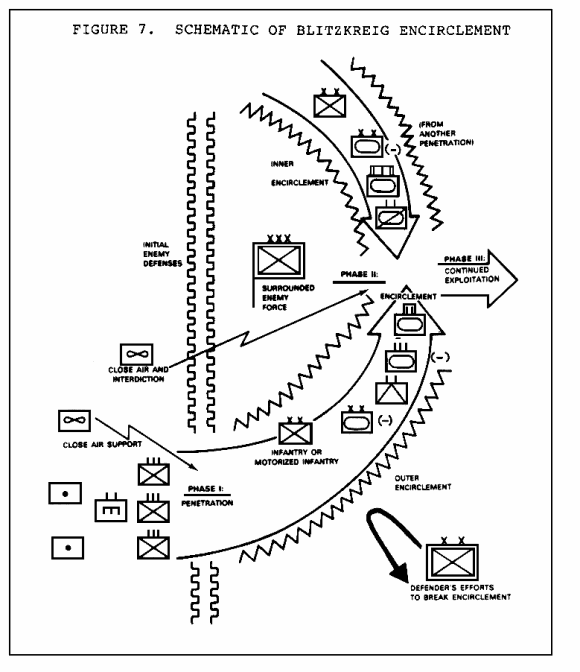
On the surface, the Blitzkrieg - the German for “lightning war” - isn’t all that dissimilar from Klopp’s “heavy metal”. Concentrated numbers targeting weak points in the opposition and winning the ball back through speed of movement and speed of decision-making against an overconfident enemy. Scoring when your opponent thinks “they can’t attack me, I’ve just won the ball”. It avoids attrition. By regaining possession quickly, “heavy metal” football wins by not fighting, a key component of the Blitzkrieg.
As seen in the quote above this was also a teaching of Sun Tzu; I gave it a quick read to see how, if at all, we could take some wisdom and apply it to football. Sun Tzu’s “Tactical Dispositions” outlined both offensive and defensive tactics; two terms that are so engrained in football we’d be stupid to ignore what they have to say. The maxims are simple:
Defensive tactics secure your position.
Offensive tactics lead to victory.
The thing that interested me most here is “position”. With positional play at the forefront of modern football it’s perhaps become a bit of a loaded term that focuses on structure and the occupation of space but in the context of war position also refers to the geographical nature of the conflict itself. If we think of a battlefield, we defend to maintain as much land as possible. When we translate that to the warzone of a game of football “position” takes on a slightly new meaning.
When planning training sessions we’re taught that it starts with In Possession or Out of Possession but rarely do we start with geography. I wrote 18 weeks worth of sessions for my UEFA B portfolio, fairly evenly split between In and Out to showcase that I could effectively coach all 10 Principles of Play. In reality, I probably should have coached 18 sessions in the opposition half (and would do if I had a do-over).
One thing I will say is that even now all of my sessions are games. Very rarely (but not never) do I coach a session where there aren’t two teams, two goals, two halves, etc, because ultimately my mentality requires it. I say I would have coached 18 sessions in the opposition half but I would never set up half a pitch, I would simply require my teams to escape their own half first. When we were taught to have numerous starting positions in sessions, for me the best way of doing this was to let the game play; sure enough the ball would start from exactly where it needed to. It would always be in the right position. But again I reiterate, this isn’t me using “position” in the way that it is used for “positional play”. I guess it’s where I am coaching rather than what I’m coaching necessarily. Because really, what I’m coaching won’t really change.
Position of the ball, or geography, appears to be a much more concrete marker of setting strategy and mentality than possession of the ball, especially since possession is almost certain to change if you’re coaching effectively - no one would rightly run a session where a defending team won the ball but never had the chance to attack, or where an attacking team lost the ball and never had a chance to regain it. That would be stupid. So what’s the point of using possession as a base? Instead I would use position. Geography and mentality.
Okay so people might not agree, or even think it’s worth the time to discuss, but let’s run a hypothetical. We plan a standard UEFA B style session:
Session Plan 1
Out of Possession
What: Mid-block forcing wide rather than central
Where: Mid-third, middle channel
How: Compactness (our Principle of Play)
When: Out of Possession when the ball progresses into the mid-third (already fairly redundant detail)
Who: Everyone (incredibly redundant detail - maybe you’d choose a few individuals but you have to coach the rest of them so effectively it’s still everyone)
Why: To stop them getting through, force them wide (obvious detail is obvious but also has no mentality attached whatsoever)
Outside of my real-time notes (apologies I couldn’t help myself) what is actually the pertinent detail in there? It’s probably what we’re doing (mid-block) and where we’re doing it (mid-third, middle channel). So where do we begin our session, what is the scenario in which we would mid-block? For argument’s sake let’s say when the opponents progress from their third to the mid-third.
But now we’ve hit a snag. If we wait for them to progress into the mid-third, what do we do whilst we’re waiting for the ball to reach us? Do they start from a goalkick or from regaining possession near their own penalty area? Do we high press and then revert to a mid-block? Do we just allow the opposition to progress whilst we stand nice and compact? Do we even shift into a high-block? Or do we think about reframing our context away from a Principle of Play as a starting point and focus more on the geography?
It’s a crude example, I get that, but it still has some valid questions. As mentioned earlier, I often found myself using more than one Principle in sessions, sometimes even as many as three in one go (which then begs the question why not just use all five?). It wasn’t necessarily what they wanted to see but to my eye there was no other way of explaining the context of my game.
Think of Jordan Henderson and Bobby Firmino in their Liverpool days. The layman (or the media pundit) would wax lyrical about how they “lead the press” for their side when actually more often than not what they did was be the fishermen, casting the nets and piloting the trawlers until the unsuspecting shoals become catch of the day in the inescapable trap. Two cold, calculated ranchers flanking in pincer-like fashion from opposite directions before pouncing. The Liverpool “press” was 90% corral and 10% lasso.
But when aping Henderson and Firmino with our 10 ingredient list of Principles we opt for “Press” never “Control and Restraint”. We don’t appreciate and understand that one doesn’t happen without the other, that the very fact they are presented as two different things is both redundant and confusing. Everything about how Liverpool worked without the ball during this time period was dictated by their mentality, not by a set of 10 principles. Position and mentality. All avenues lead to the mosh pit, and you’re going to end up on your arse. Heavy fucking metal.
The language that we use has to be authentic, it has to be simple, and it has to encapsulate, unequivocally, how we play the game. Simple huh?

“Know yourself and you will win all battles”
Sun Tzu
There is no one way of playing football. Interest and - dare I say it - fun come from the difference in what’s possible to be successful. It’s Riyad Mahrez and Jamie Vardy racing away to seal another victory in the most improbable of campaigns in a sea of goalkeepers and central defenders leading the touch and pass counts every week. It’s Gareth Bale and Lionel Messi jinking through defences at breakneck speeds amongst endless crosses into a resilient low-block.
Understanding what you are, and what you want to be, is crucial to being an effective coach. Simplifying how you explain that is your ticket to being a successful one.
The main issue with standardised approaches on courses or “badges” is that very little of what you learn ends up being your own. They are adopted, but rarely adapted. The Principles of Play framework is one such thing but we can go as far as we want in making the game our own. Coach for context and create a mentality that allows that.
I have started to focus on the geography of the ball rather than the ownership of it as a starting point - it doesn’t matter if we’re in possession or not since the context of how we act changes depending on where we are on the battlefield. But our mentality should never change, because that breeds confusion. I find it problematic when we press with speed and intensity from opposition goal kicks and then suddenly 30 yards down the pitch we become passive, restrained, we block and force one way or the other. Mentality changes like that often mean we do neither.
Whilst the success experienced by Marcelo Bielsa at Leeds wasn’t sustainable in the end, you’d be hard pressed to find a single member of that Leeds squad who won’t defend the man to the hills. Because he was authentic in his approach and ideas, his extreme man to man +1/-1 approach never wavered and it became successful because there was very little ambiguity involved (all this from a man who didn’t even speak English yet still managed to communicate effectively with his squad).
So here’s my first suggestion: simplicity means a single mentality. If you want to press hard and fast high up the pitch, then you need to gear your game to doing that all the time. Now I know it’s easy to say but hard to practice because as soon as the opposition beat that press you need to adjust your approach, but I would say don’t. Instead your next option should be to guide the opposition to play back into those pressing areas.
Maybe this could be an alternative session plan?
Session Plan 2
What: Attacking in the opposition half
Where:
How: Swarm the ball carrier and cut off all options; break with speed and score
When:
Who:
Why: To limit time and opportunity for the opposition to play
Now half of those slots are unfilled because they don’t need to be. Everything I wanted to get across, I have managed to do so. Simple language that dictates mentality. I’ve recently begun to reclaim the word “attack” or “attacking” from the version that football (and most sport) tends to use and take it back to its roots. In fact, I like the Oxford definition used in relation to chess:
“An attempt to gain a positional advantage; a move or series of moves played with the immediate object of threatening to give checkmate or capture a particular piece; the process of making such an attempt or threat.” Oxford English Dictionary, “attack (n.), sense II.9.a,” December 2025, https://doi.org/10.1093/OED/1113210138
Football is increasingly likened to a game of chess, with tactical thinkers pitted against one another, but in a very flawed way. I agree with Jamie Hamilton on how he views the analogy, namely that a chess match requires a central mind (the coach) making all of the moves with no autonomy or affordances for the pieces (the players) to make their own decisions or even move where they want.
But using chess to define what I think of attacking is, to me, perfect. The idea that geography and context play a huge role, but also that you attack both for the ultimate goal (in football’s case actually scoring a goal) and to capture (for football, possession of the ball).
It’s always been a little short sighted, in my opinion, to limit “attacking” to when we have the ball. When the Rebels stole the Death Star plans, the Empire didn’t sit back and just defend their planetary base, they scoured the galaxy to get them back. The ending to Rogue One is one of the single most terrifying pieces of Star Wars lore, a ruthlessly destructive Darth Vader scything through the Rebel alliance as they maintain control of the plans at all costs. “Attacking” takes on a very different meaning there.
I remember back when paintballing was all the rage in my school, when birthday parties shifted from a village hall to nearly getting trenchfoot in some Surrey woodland, hiding behind disused oil drums. But some of the games at those parties were superb examples of attacking. Like “Capture the flag”. Teams fight for an object and get it to their flagpole/zone/bunker, either keeping it safe or trying to take out the other team members to gain control of it. The possession of the object isn’t really necessary to the attacking element of the game, just the ultimate outcome (running it up your flagpole). You can attack and defend at all times, much like when in possession of the ball during a football match. Have the flag but are outnumbered very close to the opposition flagpole? Maybe you’ll retreat quickly, remove the danger and regroup for your own offensive. Opposition has the flag but their path is tricky ahead so you can flank them from three sides? Well attack with speed and coordination to take out as many opponents as possible and try to win the flag. In other words, if we have the object we attack the goal; if we don’t have the object we attack the people who do. In and Out, we can attack. This mentality never changes, our action is simply based on geography and context.
And this is where my second suggestion comes in: simplify your geography. Just as the very nature of the game gives us both possession states and gives us all the principles naturally, it also gives us very clear, very defined geography that never changes game to game, venue to venue. Whilst pitch dimensions may differ from club to club and definitely throughout the different age groups, we still always have our half, they always have theirs.
I’ll admit I don’t actually know where the idea of “thirds” came from in football but it’s an idea that’s here to stay. It is, however, also an idea that reinvents the wheel somewhat, or updates the car with ever more complicated systems that might make things more comfortable but also create infinitely more failure points. If you’re saying “we want to press in the final third” then by all means you can highlight different lines of engagement or zones to force into, but ask yourself if adding in layer upon layer of supplemental detail is helping or hindering? It’s fine to create training sessions that divide the pitch into thirds but you can’t go and lay down a load of flat markers on the pitch during matchday. The halves, however, will be there no matter what.
So why don’t we use these readily available reference points? Can “final third” just become “opposition half”? Does that much really change in the small area where one third changes into another? Not to mention how the actual rules change. If you can’t be offside in your own half, why would you add an unnecessary layer of detail that makes this distinction less coherent; you can either be offside, or not offside, in the middle third. This seems inefficient.
And think about it; people say they want to “play through the thirds”, a well trodden path but one that ultimately describes any and all ways of playing to the point of redundancy. The ball doesn’t mysteriously teleport from our third to theirs. Whether it goes along the floor, passing between the feet of seven players, or if it sails through the air from goalkeeper to centre forward, you are playing it through those thirds. This seems performative.
So if we want to instill our mentality onto the geography we’ve been given (because let’s face it, our half/their half isn’t very inspiring) then we should do it and make it personal. Make it authentic. I’ve started to use the terms “escaping half” and “attacking half” as both sum up my approach a little bit more. I feel it’s a bit more dynamic than simply saying “first/middle/final third”. Even using “defensive/middle/attacking” I find a bit meh. In football these days “defensive” has become such a loaded term that it opposes the mentality I want my players to have - we’re not passive in this zone. We don’t camp in and contain them, but will always look to actively force them back into the “attacking half” or win the ball and break. Similarly modern discourse talks so much about the “mid-block” that it almost seems predetermined when talking about the “mid-third” that you have to block in this area when you absolutely don’t, as if the space was created and named for the action rather than thinking of all the things you can do. You can corral and press in the middle of the pitch, much like Henderson and Liverpool used to. And let’s face it, you don’t just attack in the “attacking third” (ask Kenny McLean).
These are reasons why personal language is going to be so much better than standard, cookie-cutter, learned language that might come with preconceptions. Make it our own so that it means something to us and our players, get their input so there is no miscommunication and misunderstanding. Remember, avoid homogeneity and promote authenticity.
When we have the ball in our half, in no way are we being defensive with it. We are always actively looking to play through the opposition, combining as a team to escape quickly, fluidly and effectively. And in their half of the pitch we attack them if they have the ball, we attack the goal if we have the ball.
“Escaping Half”. “Attacking Half”. At the moment these are working for me, but there are numerous ways that you can shape this using your own language. If you do like to block by all means use terminology to describe that without doubt. Maybe you have the “containing half” and the “breakout half”. These may usefully describe a solid defensive foundation that looks to counter attack quickly. I also like the idea of calling the “attacking half” the “pressure half” because again it sums up my mentality. But this obviously comes with a lot of preconceptions on what we mean by “pressure”. It is also a loaded term because of the very same gegenpressing German we began the piece with, so much so that we forget how we use it in everyday parlance.
We remember Klopp, we forget Bowie and Mercury. “Under Pressure”. It’s merely a measure of stress testing, of seeing how secure something is under immense force. We can be under pressure with the ball, but also under pressure without it. A team that can never escape their own half, or even their own penalty area, is bound to fail sooner or later. Pressure isn’t just an out of possession action, it’s a flow state, a fundamental measure of the psychological context of the game.
This is just something that I’ve been playing with this season. Like anything it’s a work in progress and the proof is really in how well my players understand the hypothetical pudding. But giving them clearly defined, unchanging geographical references tied to an unchanging mentality is something I believe will make us stronger.
Our “model” may change based on the context of the game but we should know our overall approach more clearly. Maybe a more footballing term would be our “identity”. But importantly it allows us to adapt and react to context, live, as it happens in game because our fundamental mindset is unwavering. Whereas Thomas Frank was supposedly hyper-focused on set ups to nullify ever changing oppositions, maintaining a fixed mindset can better inform training; whilst the “how” might change and different "principles of play” get used, they stop becoming the focus as a means of combating what we think the opposition might do next week. We learn numerous options to beat what is thrown at us, all tied together by one single mentality. We become our own mentality monsters.
It wouldn’t be a GHCoaching ramble without mentioning Brentford FC, and recently I’ve been thinking about how I would sum up what makes the Bees, the Bees. What is their mentality, their identity? And more often than not it reverted back to the homogenous; it got stuck in football talk of width and pace and directness. But after fighting (and not very arguably outplaying the champions elect Arsenal recently) a lot of language from fans, and from Keith Andrews, settled on something which I think sums us up perfectly. “Relentless”. Or in the words of Bob Mortimer “bastards”.
All these responses - Terminators, hell, bastards - they’re not footballing terms at all. Yet they’re the inescapable product of a singular, bloody-minded mentality that underpins everything the players do in response to footballing context each 90 minutes. Language and words that reveal the very heart of what it means when we play.
And you know what? If I ever reach the final stage of pure enlightenment where all shape and form and understanding disintegrate off this mortal plane, maybe I will cast off the shackles of unnecessary language completely and coach without the need for words but instead by unwavering vibes. Maybe one day I’ll reach football nirvana and escape these halves, thirds, channels, half spaces, zone 14s and second 6 yard boxes, the sea of endlessly confusing language to simply say “a pitch”, and arrive free of all other notions to one universal truth in every moment of the game:
“Attack”.


Comments